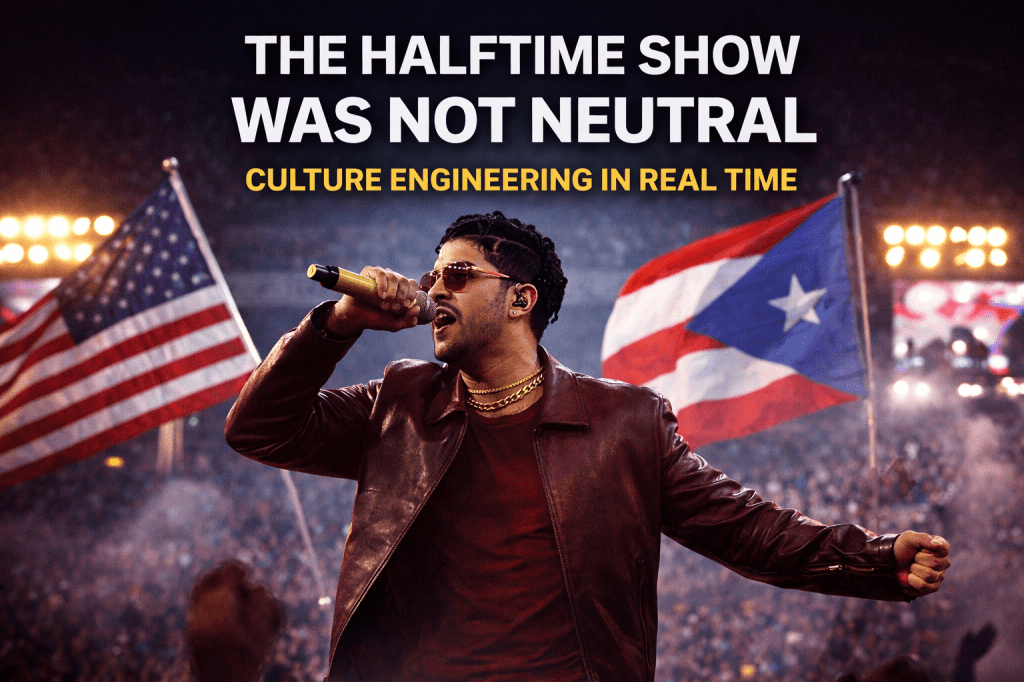
The Super Bowl Halftime Show Is Culture Engineering, Not Just Music
The Super Bowl halftime show is one of the largest synchronized attention events in the world. It is not just entertainment. It is a carefully curated platform for social signaling, agenda shaping, and cultural branding. By featuring Bad Bunny, a Puerto Rican reggaeton artist performing largely in Spanish, the NFL executed a sophisticated exercise in political marketing, sparking division while advancing subtle narratives around identity, inclusion, and cultural norms.
The Logic of Mass Cultural Platforms
Major mass events are not neutral. They are coordinated broadcasts engineered to influence cultural norms and social sentiment on a national scale. Platforms like the Super Bowl halftime show use familiar formats such as music, spectacle, and performance to transmit value systems without overt political messaging.
This is soft power in its most effective form. Ideas are embedded through emotion and association rather than argument. When organizers select artists who embody specific identities or cultural signals, they normalize certain narratives while challenging others, all under the protective cover of entertainment.
The audience fights over the surface controversy while the deeper shift happens quietly.
Bad Bunny as a Strategic Choice
The NFL does not select halftime performers at random. It optimizes for reach, branding, and narrative alignment.
Bad Bunny checks every box. He expands global reach as one of the most streamed artists in the world. He targets younger and Latino demographics in a diversifying United States. He positions the league as culturally progressive in a polarized era.
The performance itself was structured to provoke reaction. Singing primarily in Spanish created immediate friction for many viewers who felt excluded or confused. That reaction was predictable. It was also useful.
At the same time, Bad Bunny is a U.S. citizen from Puerto Rico, a fact that complicates any simplistic framing. Ending with patriotic symbolism and unifying language allowed supporters to frame the performance as inclusive while critics risked being portrayed as intolerant.
This was not accidental. It mirrored ongoing national tensions around immigration, identity, and enforcement without ever stating a policy position. The signal was sent without argument. The audience did the rest.
Manufactured Backlash Is Part of the Playbook
The controversy was not a failure. It was the mechanism.
In modern media ecosystems, backlash extends reach. Outrage generates headlines. Emotional reactions sort people into moral categories. Supporters are framed as enlightened. Critics are framed as resistant or regressive.
This framing is not always explicit or uniform, but it is reinforced by media incentives and social pressure. The result is reputational enforcement without formal coercion.
This same playbook appears in award shows, corporate advertising, national tragedies, and even public health campaigns.
Whether viewers loved the performance or hated it is irrelevant. They talked about it. They argued about it. They reinforced the cultural frame simply by engaging with it.
That is how institutional messaging works in the age of mass media.
The Libertarian Critique
Libertarians do not oppose culture. We oppose engineered consensus.
Individual expression is not the issue. Institutional coordination is.
When powerful organizations use monopolized cultural moments to shape acceptable beliefs and socially penalize dissent, culture begins to function like soft law. No statute is passed. No right is formally revoked. Behavior is regulated all the same.
You do not need censorship when stigma does the work.
True cultural freedom is organic. It emerges from individuals choosing, creating, and rejecting ideas freely. It is not manufactured through top-down signaling that divides the public while claiming unity.
Bad Bunny’s halftime show succeeded brilliantly on its own terms. But recognizing the strategy behind it matters.
If you do not question who controls the narrative, you will eventually mistake influence for consensus and compliance for culture.
 LimitGov
Leave a comment