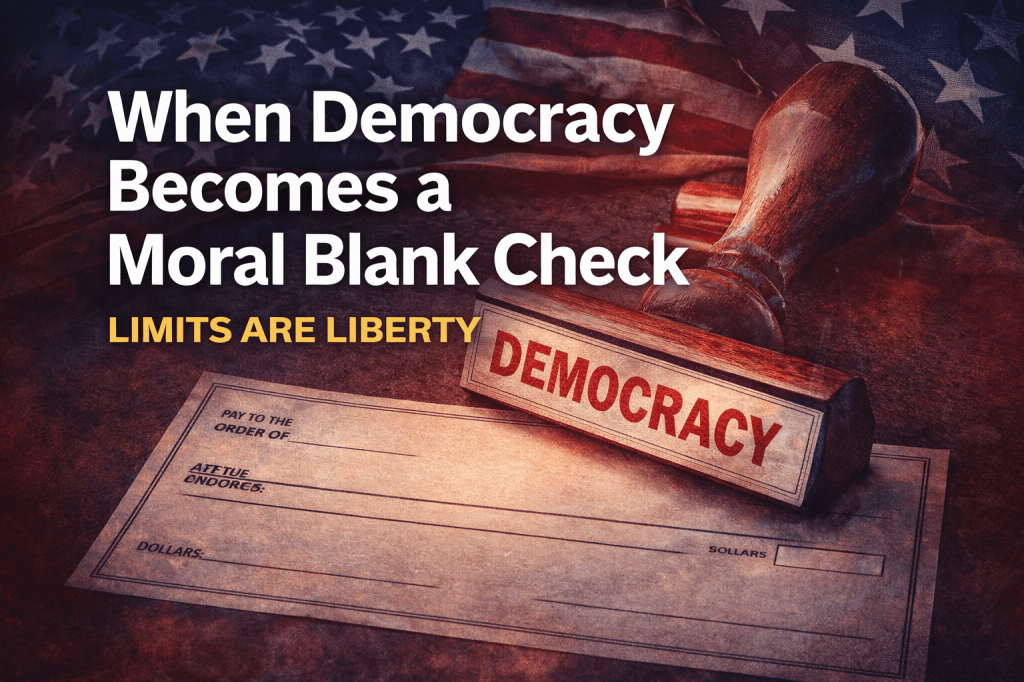
“Democracy” has become the most powerful word in modern politics.
Not because it is well defined.
Not because it is carefully applied.
But because it is rarely questioned.
Once invoked, it ends debate.
When an action is framed as “protecting democracy,” scrutiny stops. Limits dissolve. Objections are treated as threats. And power expands without needing to justify itself.
This is not an accident. It is a pattern.
Democracy as Permission, Not Process
In theory, democracy is a mechanism for choosing representatives. In practice, it has been elevated into a moral authority.
If something is done in the name of democracy, it is assumed to be legitimate. If it produces harm, that harm is reframed as necessary. If it violates rights, those rights are treated as obstacles.
Democracy stops being a method.
It becomes permission.
And permission is the most dangerous thing power can be given.
The Blank Check Logic
The logic works like this:
- Declare a threat to democracy.
- Assert urgency.
- Suspend normal limits.
- Expand authority.
- Treat dissent as danger.
This sequence now repeats across policy domains.
No coup required.
No dictator needed.
Just a moral narrative and a compliant public.
Speech: “Defending Democracy” Through Suppression
Censorship is now routinely justified as a democratic necessity.
Content moderation becomes “election integrity.”
Deplatforming becomes “public safety.”
Government pressure on private companies becomes “coordination.”
Speech is not banned outright. It is discouraged, buried, stigmatized, or quietly removed. The result is the same.
When democracy is treated as sacred, free speech becomes conditional. Allowed only so long as it does not threaten approved outcomes.
That is not democratic self-government.
It is narrative enforcement.
Surveillance: Safety Framed as Civic Duty
Mass surveillance was once sold as a temporary emergency measure. It is now normalized.
Bulk data collection. Metadata retention. Algorithmic monitoring. Behavioral profiling.
All justified by democratic mandate and public fear.
If you object, you are told you are undermining safety. Or worse, democracy itself.
In a republic, surveillance must justify itself against liberty.
In a democracy worshiped as an end, liberty is expected to justify itself against surveillance.
That inversion is not theoretical. It is lived reality.
Property: Majority Rule as Expropriation
Civil asset forfeiture allows the state to seize property without a conviction.
Zoning laws erase ownership through regulation.
Emergency declarations suspend contracts.
Economic controls are imposed by administrative rule.
All of it defended as serving democratic goals.
If enough people want it, it becomes righteous.
The Founders warned against this explicitly. Property rights were not protected because they were popular, but because they were necessary to prevent power from becoming total.
Democracy without limits does not respect property.
It consumes it.
Administration: Rule Without Accountability
The modern administrative state is the clearest example of democracy as blank check.
Unelected agencies write rules with the force of law.
They enforce those rules.
They adjudicate disputes arising from them.
This consolidation would be unthinkable if done openly by a king.
But when justified as democratic governance, it is treated as progress.
Accountability disappears. Elections become symbolic. Power becomes permanent.
This is not self-rule.
It is managed compliance.
Why This Keeps Happening
Because democracy has replaced restraint as the highest political good.
Once outcomes matter more than limits, any tool becomes acceptable. Once intentions matter more than structure, any abuse can be excused.
People do not abandon liberty because they hate it.
They abandon it because they are told it stands in the way of something noble.
Democracy has become that noble thing.
The Republican Alternative
A republic does not ask whether power is popular.
It asks whether power is permitted.
It assumes:
- Humans are fallible
- Incentives matter
- Authority must be divided
- Limits must bind even well-intentioned actors
That is not cynicism.
It is institutional humility.
The purpose of a republic is not to guarantee good outcomes. It is to prevent irreversible ones.
The Warning
When democracy is treated as sacred, it becomes untouchable.
When it becomes untouchable, it becomes dangerous.
Power does not need to seize control when it can claim moral entitlement.
It only needs applause.
If democracy cannot tolerate limits, it will destroy the liberty it claims to protect.
And it will do so legally, publicly, and with popular approval.
That is the danger of the blank check.
 LimitGov
Leave a comment