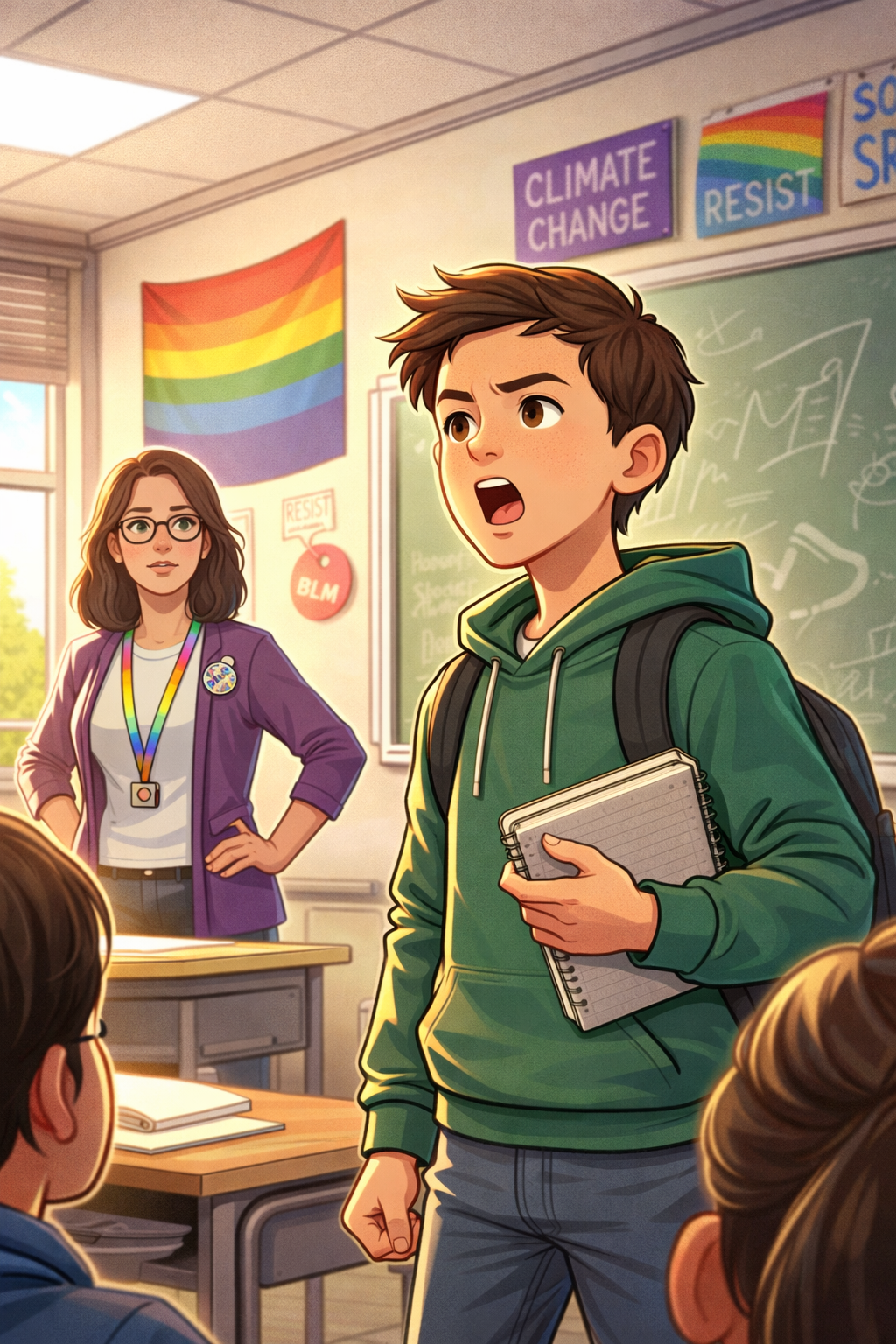
In the bustling heart of a typical American middle school classroom, think faded posters of historical figures on the walls, desks etched with decades of doodles, and the faint hum of fluorescent lights, a group of wide-eyed tweens sat glued to their seats. It was social studies hour, and Ms. Evergreen, the teacher with her rainbow lanyard and ever-present coffee mug emblazoned with “Change Starts Here,” was holding court. The topic? The upcoming “Day of Action” is a student-led walkout protesting U.S. immigration policies and ICE enforcement. The air was thick with that mix of adolescent curiosity and the subtle undercurrent of adult agendas.
Ms. Evergreen leaned against her desk, her voice measured and seemingly impartial, like a news anchor reciting the weather. “Now, class, remember: protesting is a cornerstone of our democracy. It’s your First Amendment right, think Martin Luther King Jr., marching for civil rights, or the brave souls at Selma. This walkout is about standing up for what’s right, just like those heroes did. And don’t worry, there won’t be any detentions or makeup work if you choose to participate.
In fact, you might even earn some extra civics credit for showing real-world engagement!” She smiled broadly, her words dripping with encouragement, though she conveniently skipped over any counterarguments or the fact that not everyone saw ICE as the villain in this tale.
The class murmured excitedly, some kids fist-bumped under their desks, others scribbled protest sign ideas in their notebooks. But then, little Timmy in the front row raised his hand. “Ms. Evergreen, what’s the deal with ICE anyway? Why are these policies even a thing?”
Ms. Evergreen nodded sagely, adjusting her glasses. “Well, Timmy, some people say these policies are about protecting our borders and ensuring legal immigration, keeping things orderly, you know?” She waved her hand dismissively, as if swatting away a fly. But then her tone shifted, her eyes widening with dramatic flair. “But let’s be real, class. These harsh crackdowns are rooted in racism and fear-mongering. Mega Republicans are pushing them to target hardworking migrant families who are just trying to make a living and support their loved ones. It’s heartbreaking! And it doesn’t stop there; these same folks are endangering kids like you by refusing common-sense gun laws.
How many school shootings do we need before they act? Oh, and don’t get me started on their book bans in libraries, silencing diverse voices, or their anti-trans policies that bully vulnerable students. It’s all connected, class. We have to fight back!”
The room fell into a hush, a few kids nodding vigorously while others shifted uncomfortably. Whispers rippled like a game of telephone: “Yeah, Republicans hate everyone!” “My dad voted for them. Does that make him bad?”
That’s when young Gavin, a sharp-witted 12-year-old with a backpack full of history books and a quiet fire in their eyes, raised their hand high. Ms. Evergreen pointed. “Yes, Gavin?”
Gavin stood up slowly, heart pounding like a drum solo, but their voice was steady. “Ms. Evergreen, before I say anything, I want to reserve my First Amendment right to speak without being interrupted. I’m… I’m a little afraid to speak up, honestly. Can you promise no punishment or interruptions if I share how I feel?”
The teacher blinked, caught off guard, but nodded with a tight smile. “Of course, Gavin. This is a safe space. Go ahead.”
Gavin took a deep breath, stepping to the front of the class like a pint-sized orator on a mission. The room went pin-drop silent as they began, his words tumbling out with the passion of someone who’d been bottling it up for too long.
“Class, Ms. Evergreen, it’s really disturbing how this discussion is being led straight to one conclusion: that only racist, anti-LGBTQ Republicans who want to endanger children would skip this protest against ICE. That’s not fair, and it’s not true. My family holds conservative beliefs, and we have our own views on things like firearms policy. We believe in the Second Amendment because it protects people, not endangers them. We have nuanced perspectives on immigration, too. We want secure borders, but that doesn’t make us hate migrants or families trying to build better lives.
“But here, in our classroom, I’m being made to feel like a monster just for thinking differently. You’re forcing everyone into this one-sided political box. Calling policies ‘racist’ without real debate, weaving in unrelated topics, guns, book bans, trans issues, to vilify one side, chilling dissent, and pitting us kids against each other. This isn’t fostering critical thinking; it’s manipulative, forcing a political consensus that silences voices like mine.
I’m afraid to speak up because I don’t want to be labeled or bullied by my own teacher or peers. This isn’t education; it’s manipulation.
“If this doesn’t stop right now, if we can’t have real, balanced talks without the bias, I’ll tell my parents, we will document it. We will escalate it. And we will not be quiet.
I’m not scared of you, Ms. Evergreen, or the teachers’ unions pushing this woke, divisive agenda that’s attacking young minds like ours. You should be ashamed of turning our class into a battlefield, forcing consensus instead of fostering real thought.
“We deserve better. We deserve a real education.”
Gavin sat down to stunned silence, then a smattering of claps from a few brave souls. Ms. Evergreen’s face flushed, the rainbow lanyard suddenly looking a tad less vibrant. In that moment, the classroom wasn’t just a room; it was a spark, a reminder that even in fantasy, one kid’s voice could shake the status quo. And who knows? Maybe in the real world, it will inspire a few more to stand up too.
Fiction
A short story about how political pressure can masquerade as “civics” inside compulsory institutions. Any resemblance to real people or events is incidental.
 LimitGov
Leave a comment