The CCTV Lie They Keep Selling
I heard a segment on the Gee and Ursula show, 5/6/2026, where Gee tried to argue that people who oppose government CCTV surveillance are hypocrites if they own Ring cameras.
That argument collapses instantly under even the slightest philosophical pressure.
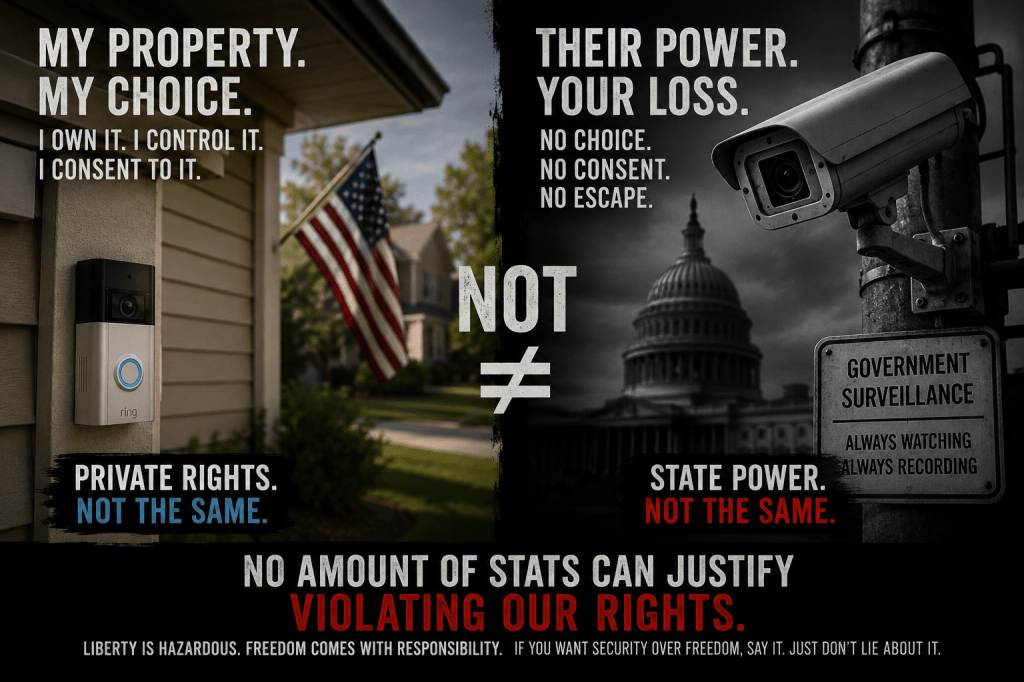
A private citizen putting a camera on their own property is not remotely the same thing as the government monitoring the public.
One is an individual exercising property rights.
The other is the state exercising power over citizens.
Those are not equivalent concepts. They are opposites.
A homeowner has the right to secure their home, monitor their driveway, and protect their family. That authority comes from ownership and consent. You can choose whether or not to walk onto someone’s property. You can choose whether or not to buy a Ring camera yourself.
You do not get that same choice when the government blankets society with surveillance infrastructure funded by your own tax dollars.
The difference between private action and state power is not a technicality. It is the entire foundation of a free society.
This is the same dishonest logic people use when they say, “Well, social media companies censor speech, so why can’t the government?”
Because corporations are not governments.
One can block you from a platform.
The other can imprison you.
If someone cannot distinguish between private rights and state authority, they are missing the most basic principle of liberty.
Then came the predictable appeal to statistics.
Crime prevention.
Money saved.
Efficiency.
Safety.
This is where authoritarians always go when they run out of principles.
But rights are not subject to a cost-benefit analysis.
Either something is morally acceptable, or it is not.
The argument that surveillance “works” is irrelevant to whether it is justified.
You could reduce crime even further with warrantless searches, mandatory tracking devices, curfews, or government drones hovering over every neighborhood 24 hours a day.
A prison is technically “safe” too.
That does not make it freedom.
The people who scare me most are not criminals. It is the people who constantly argue that liberty should be surrendered for the “greater good.” History is filled with governments doing horrific things under that exact slogan.
Freedom is dangerous.
Always has been.
A free society requires personal responsibility, risk tolerance, and acceptance that bad things will sometimes happen.
If someone wants to openly argue that security matters more than liberty, fine. At least that is an honest position.
But stop pretending mass government surveillance is the same thing as a homeowner putting a camera over their garage, or even corporations having surveillance on private property.
And stop pretending rights suddenly disappear because someone showed you a spreadsheet with favorable statistics.
That mindset is how free societies slowly become permission-based societies.
One camera at a time.
Editor’s Note Added After Gee’s Response
After sending this piece to the show, Gee was kind enough to respond, and he made one point worth acknowledging.
He is right that, generally speaking, people do not have the same expectation of privacy in public that they have in private spaces. That matters.
Private citizens recording the public is not automatically a rights violation. In fact, Washington law already reflects this basic logic in many situations. If a conversation or interaction is happening somewhere that cannot reasonably be considered private, the privacy concern is very different than someone secretly recording inside a home, bedroom, office, or other genuinely private setting.
So yes, Gee is correct that a Ring camera may record people who are in public view, even if the camera itself is mounted on private property.
But my argument was never that all public recording is inherently wrong. My concern is centralized government surveillance and the normalization of a security state.
That does not weaken my argument. It sharpens it.
The issue is not whether a citizen can record something visible from a public place. The issue is whether the government should be building, expanding, and normalizing permanent surveillance infrastructure designed to monitor the public.
That is a different animal entirely.
A private citizen recording a public interaction is one person documenting what they can lawfully observe.
A government surveillance system is the state watching the people.
Those are not the same thing.
The government has police powers. Prosecutorial power. Taxing power. Regulatory power. The power to detain, investigate, charge, seize, and imprison. That means the government must be held to a radically higher standard than a homeowner, journalist, protester, business owner, or random guy with a phone.
That is why constitutional protections exist in the first place.
The Fourth Amendment protects against unreasonable searches and seizures. The Fifth Amendment protects citizens from government coercion and compelled self-incrimination. The broader principle is simple: government power must be restrained because government power is uniquely dangerous.
I do not want to live in a police state.
I do not want to live in a security state.
I do not want every public space treated like a checkpoint, every citizen treated like a suspect, and every appeal to “safety” used as a permission slip for more government monitoring.
Liberty requires risk.
Freedom requires responsibility.
And rights are not erased just because surveillance can be sold with a tidy statistic and a public safety bow wrapped around it.
So I appreciate Gee’s response. He raised a fair clarification.
But my central point remains unchanged:
Private recording and government surveillance are not morally, legally, or politically equivalent.
One is citizens watching their world.
The other is the state watching its citizens.
That difference matters.
 LimitGov
Leave a comment